Autonomous Process Control for Scaling Production Output
Assure operating stability and prevent problems before they stop production
Flexxbotics enables a closed-loop in your factory to detect issues and make controlled updates
Discover How it WorksClose the loop before problems impact profits
Our platform enables you to prevent issues by automating the decision and response loop
Autonomous Process Control is the Flexxbotics solution for observing production conditions, detecting process drift or risk, and triggering authorized actions before defects, downtime, or production loss occur.
Slow corrections cost production in advanced manufacturing
Delayed detection and resolution cause small process issues to become major failures, scrap, and lost profits.
- Preventable downtime when fault conditions are discovered too late
- Shortened tool life or machine failure due to out of spec operation
- Nonconformance issues from inconsistent process corrections
- Dependence on a few experienced individuals
- Slow time to resolve
How It Works
01
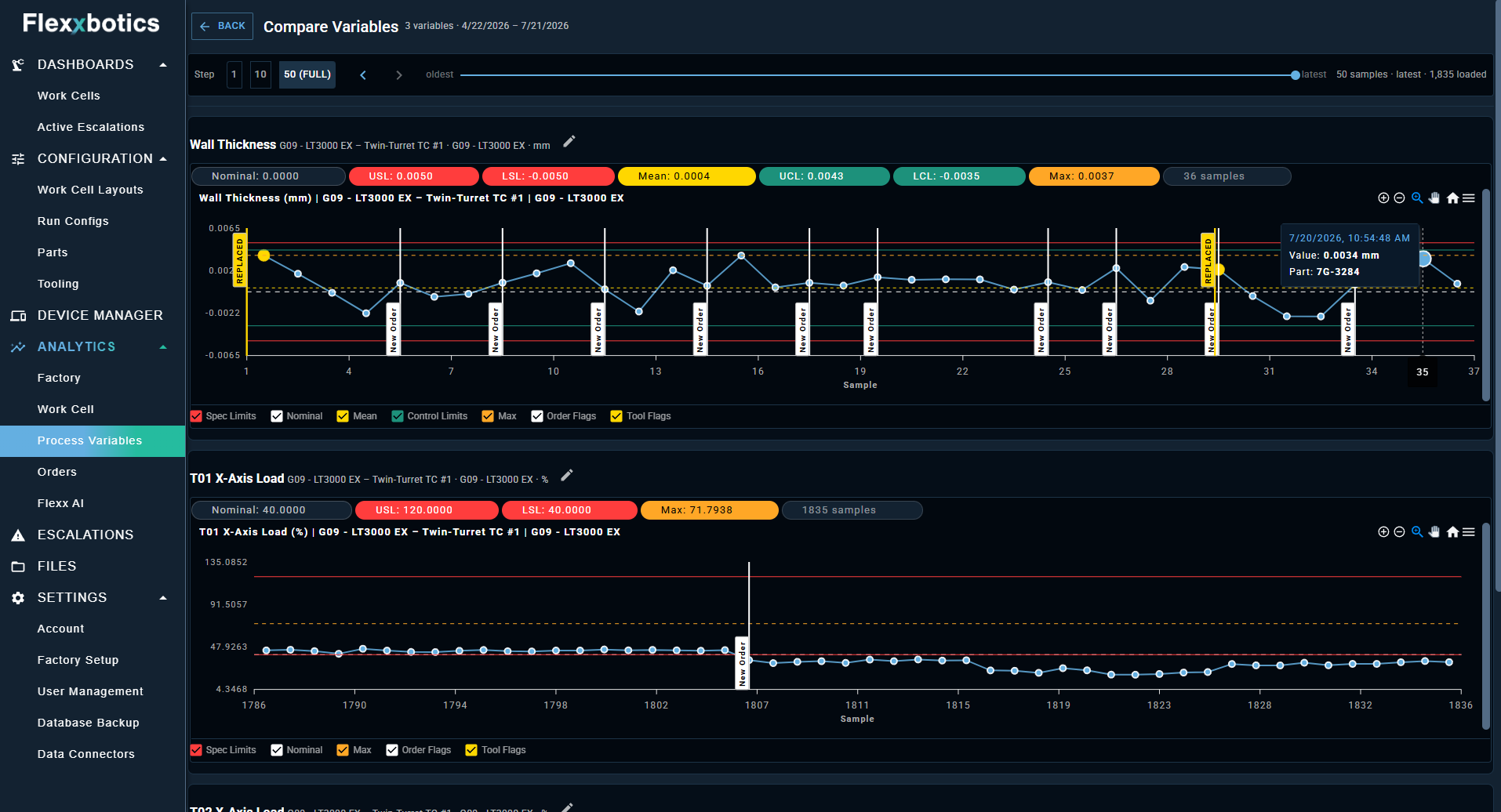
Observes Production Conditions
Tracks live factory conditions for variation as production occurs across cells, lines, and plants
02
Detects Drift & Identifies Responses
Identifies operating conditions that precede downtime, quality issues, tool degradation, and others
03
Invokes Authorized Actions
Determines what previously approved action should be taken based on operating rules and thresholds
01
Observes Production Conditions
Customer Results Realized
Throughput Improvement
0

Capacity Increase
0

Utilization Rate
0

Achieve Closed-Loop Control
- Reduces unplanned downtime by detecting deviations before production stops
- Improves throughput by correcting issues before production slows
- Prevents defects by keeping processes within specified limits
- Extends asset and tool life
- Enables longer unattended production runs
Flexxbotics takes advanced automation to the next level with autonomous process control.
Greg Wilson Jr.
President, PMI
Way Beyond SCADA & IIoT Monitoring.
Traditional factory systems tell teams what happened. Flexxbotics determines what is happening, what is likely to happen next, and what should be done about it.
Empowers your factory experts for super human results
Functionality in the Autonomous Process Control solution draws on capabilities in the Flexxbotics Platform
Production Definition
Flexxbotics combines product twins, process twins, and asset twins for a complete production definition
Operating Rules & Limits
Uses production actuals to define the rules and thresholds that detect and control process outcomes
Detect & Recognize
Identifies deviating conditions across production operations, equipment variables, and quality results
Event-Driven Response
Responds to manufacturing event patterns as they occur using preapproved actions
Proactive Escalations
Isolates issues for review, correction, or automated intervention before production is impacted
Intelligent Recovery
Helps production automation recover from non-safety related work stops for continuous operations
Human-in-the-Loop Oversight
Enables teams to define where automation can act independently and where human intervention is required
Works with Your Equipment. Now.
Flexxbotics deploys with all the machines, processes, and systems already running your plants including Beckhoff, Siemens, Allen-Bradley, FANUC, and numerous others.
Autonomous Process Control does not replace PLCs, SCADA, MES, or QMS systems. It adds a secure governing capability that detects production deviations and coordinates adjustments for greater autonomy.
Compatible With
1000+
Makes & Models
Deploys With
SAP
Oracle, Siemens & More
Scales To
Hundreds of Millions
of Rules
Frequently Asked Questions
What is autonomous process control?
Flexxbotics Autonomous Process Control continuously observes production conditions, detects process drift and risks, and triggers authorized actions before defects, downtime, or production losses occur. Flexxbotics enables closed-loop control using real-time production feedback, operating rules, proactive escalations, and human-approved corrections to improve throughput and yields. For example, SpiTrex Orthopedics reduced the overall lead time in production by 20%.
What is the difference between process monitoring and autonomous process control?
Process monitoring collects industrial data and alerts personnel to operating conditions. Autonomous Process Control goes further by detecting process drift and risk, determining appropriate responses, and securely triggering authorized actions before defects, downtime, or production loss occur. Flexxbotics closes the loop between production feedback, operating rules, and controlled corrective actions. For example, Ruland uses Flexxbotics to enable adjustments for tool wear and other factors based on inspection feedback, supporting continuous operation rather than monitoring alone.
How is Flexxbotics Autonomous Process Control different from traditional Advanced Process Control (APC)?
Traditional Advanced Process Control (APC) uses process models and optimization algorithms to regulate production variables within operating limits. Flexxbotics Autonomous Process Control extends closed-loop control across incompatible machines, automation equipment, and factory systems to enable greater levels of production autonomy. It observes real-time production conditions, detects process drift and risks, and invokes authorized actions using operating rules, thresholds, and human-in-the-loop oversight.
How does Flexxbotics maintain human oversight and control of autonomous manufacturing?
Flexxbotics uses human-in-the-loop oversight to define where automation can act independently and where human authorization is required. Its Control Plane governs operating rules, approvals, escalations, and authorized actions while recording production events and decisions for compliance traceability. This enables greater manufacturing autonomy while preserving human authority over production decisions.
Flexxbotics Autonomous Process Control observes real-time production conditions, detects drift and risk, and triggers authorized automation actions to prevent defects, downtime, and production loss.
Increase Throughput and Quality
Use autonomous process control to keep production running and increase margins