The Protocol-Level Drivers for
Deeper Industrial AI Data
Create equipment connectivity 22x faster than custom interfacing.
Enable secure communication and capture the type of contextual data AI needs.
Download Free SoftwareIndustrial Interfaces for the AI Era
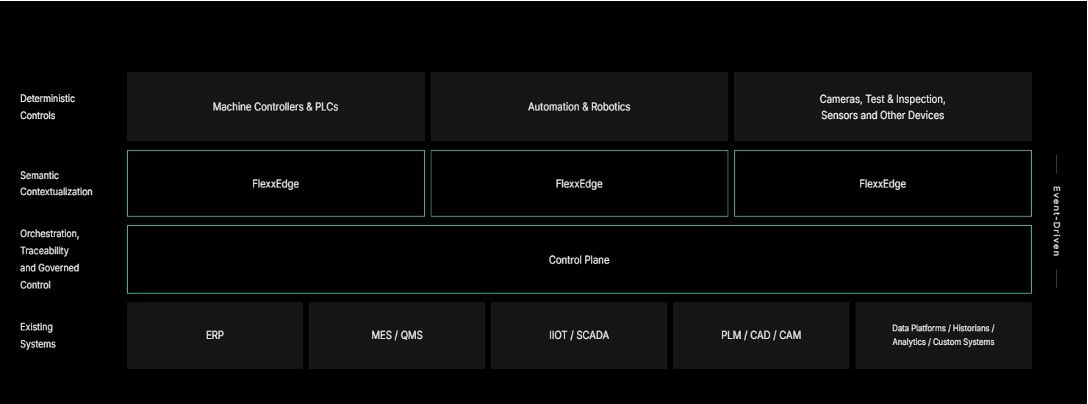
Flexxbotics Drivers, called Transformers, are the device communication layer that connects industrial assets to Flexxbotics Edge Software for protocol-level data access, data contextualization, and controlled equipment interaction.
Capture & Transform Industrial Data
Flexxbotics Drivers connect to factory machines, translate protocols, contextualize data, and secure bi-directional equipment communication in the Flexxbotics Platform.
Equipment Incompatibilities are Everywhere
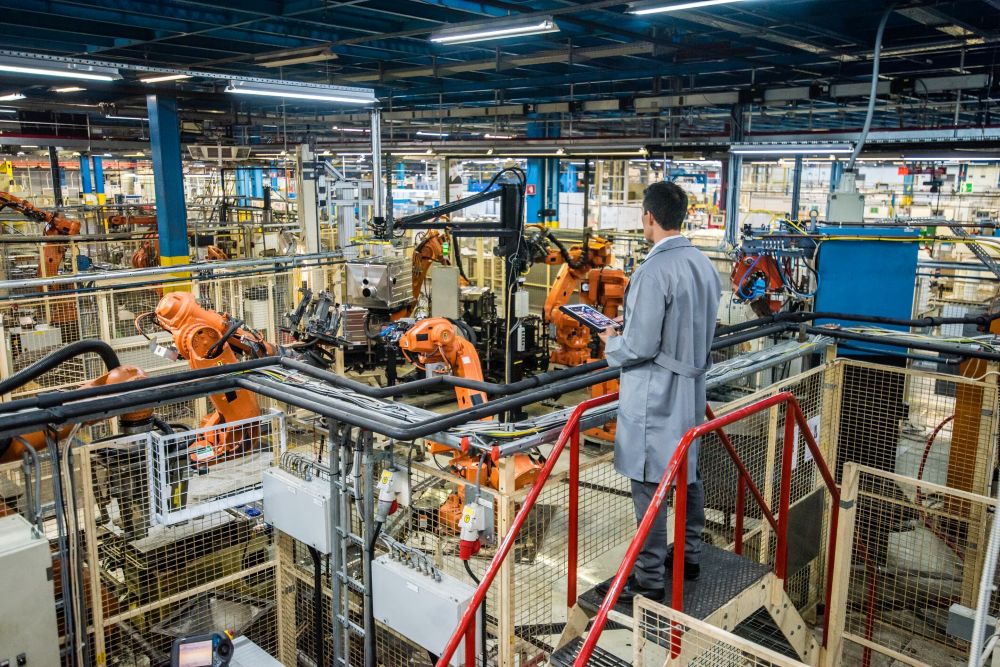
Machines, PLCs, test & inspection, automation, robots, cameras, lasers, sensors, and other assets rely on numerous different controllers that were never designed to work together.
Different protocols, data structures, and function calls in plant equipment often make smart factory initiatives complex and difficult. Flexxbotics fixes this to provide true interoperability.
Works With Existing Factory Controllers
Flexxbotics Drivers do not replace deterministic logic in machine controllers, PLCs, or OEM device software.
They provide a secure communication layer to make incompatible equipment interoperable and get the deep protocol-level data required for analytics, autonomy, and Industrial AI.
How They Work
01
Connects Device
Establishes communication between device endpoints and the Flexxbotics Edge Software.
02
Reads Protocol Data
Captures signals, variables, events, states, tags, measurements, and device outputs.
03
Applies Context
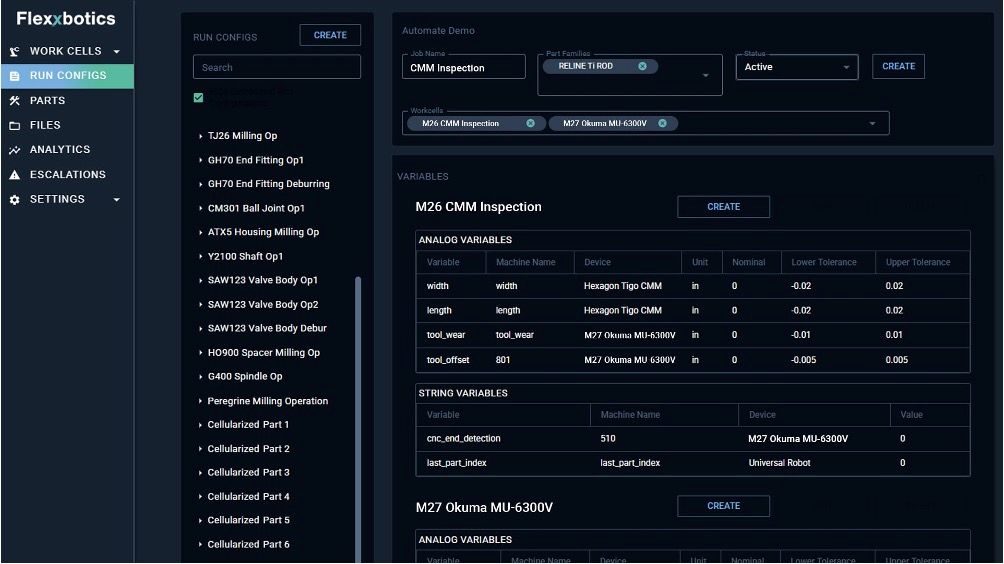
Maps raw signals to detailed production meaning at ingestion.
04
Routes Data
Securely publishes structured data to the Flexxbotics Platform.
05
Enables Action
Option for controlled write-back to safely make variable updates and closed-loop adjustments with human-in-the-loop control.
01
Connects Device
Beyond Black-Box Connectors
Most IIoT and SCADA providers restrict your ability to build or even edit connectors, forcing vendor dependency and limiting the use of AI for programming.
Flexxbotics gives you direct access to open-source Python code, command methods, and API services to create and extend drivers and enable AI-assisted coding with your preferred LLM.
One of the challenges we've had is machine interfacing complexity which Flexxbotics solves.
Dustin Vinci
Engineering Manager, Ruland Manufacturing
You Control Driver Development
Flexxbotics gives your team control to develop, configure, validate, and deploy drivers across your factories.
Editable Driver Logic
Modify, test, and deploy drivers without waiting for vendor release cycles.
Open-Source Availability
OSS drivers available for a wide range of standards and protocols.
Use Your Own AI for Coding
Bring your own model (BYOM) to build and extend drivers faster.
Supports Custom Equipment
Create drivers for non-standard machines, legacy devices, and custom controllers.
Version Controlled Deployment
Develop, distribute, and deploy drivers with centralized version control.
Built for Deep Protocol-Level Access
Device Communications
Connects industrial machines and devices to the Flexxbotics Platform.
Physical & Logical Connections
Creates runtime connections to controllers, equipment systems, and workcells.
Binds Equipment to Machine Models
Defines & associates OEM, model, controller type, and the driver used with each device.
Protocol Translation
Converts raw protocol signals into structured and normalized production data at the source.
Semantic Contextualization
Maps data to parts, operations, events, machine states, tooling, asset hierarchy, and more.
Secure Event Routing
Routes device events securely for real-time coordination, automation, and updates.
Many-to-Many Compatibility
Drivers inherit protocol-level interoperability across all endpoints.
Bi-Directional Read & Write
Supports status reads, variable reads/writes, parameter setting, commands, and polling logic.
Command Execution
Option to use command methods that can trigger specific device or workflow actions.
Universal Connectivity & Interoperability
Flexxbotics Drivers interface with over 1000 makes & models of industrial equipment, and are used for all types of controllers from Siemens, Rockwell, Mitsubishi, FANUC, and others.
PLCs, machine controllers, test & inspection equipment, robots, cameras, lasers, sensors, and custom devices.
Flexxbotics Edge Software runtime in the platform for real-time data capture, contextualization, and workcell coordination.
Connects Both Standard & Custom Equipment
Flexxbotics Drivers enable data acquisition and interoperability across standard protocols, industrial networks, controller interfaces, and custom equipment connections.
You can build your own open-source Drivers using the Studio and API in free Flexxbotics Edge Software.
Fast & Easy Installation
Use Flexxbotics Edge Software to install open-source Drivers in minutes.
Operates in the Edge Software Runtime
Drivers operate using the FlexxCore technology of the Flexxbotics Platform to support these solutions.
Industrial Data Connectivity
Captures highly detailed data from every production source.
Automated Production Tracking
Tracks real-time actuals across machines, jobs, parts, orders, and shifts.
Process Characterization
Creates live process profiles, baselines, and limits for predictive insights.
Autonomous Process Control
Detects, escalates, and corrects production deviations in a closed-loop.
Frequently Asked Questions
How do Flexxbotics Device Drivers work?
Flexxbotics Drivers, called Transformers, are Python-based software interfaces that connect industrial equipment to the Flexxbotics Edge Software with FlexxCore. They establish device communication, capture protocol-level signals, apply production context, and securely route structured data. Transformers also support optional controlled read/write operations for secure variable updates, commands, and closed-loop automation with human-in-the-loop oversight.
What industrial protocols does Flexxbotics support?
Flexxbotics supports industrial protocols and interfaces including OPC UA, MQTT, MTConnect, Modbus TCP, PROFINET, EtherNet/IP, DeviceNet, TCP/IP, Siemens S7comm, Beckhoff ADS, EIP-Logix, MELSEC, FANUC FOCAS2, HEIDENHAIN TNC, Haas NGC, and serial connections. Its Device Drivers also support proprietary controller interfaces and custom equipment connections without waiting for vendor updates or roadmaps. Flexxbotics gives your team control to develop, configure, extend, and validate Drivers in an open development architecture.
How does Flexxbotics handle proprietary equipment interfaces?
Flexxbotics uses protocol-level Device Drivers, called Transformers, to translate proprietary device signals, data structures, and command methods into a common industrial data model. Drivers provide access to machine variables, states, events, and parameters while supporting optional controlled read/write operations, enabling equipment from different manufacturers to work together reliability and securely. Flexxbotics gives your team control to develop, configure, extend, and validate Drivers in an open development architecture.
Can companies develop their own device drivers for custom hardware and legacy controllers?
Yes. Flexxbotics provides an open development architecture for creating, modifying, testing, and deploying custom Device Drivers. Developers can use Python with the Edge Software’s Studio and APIs to build interfaces for non-standard machines, legacy devices, custom controllers, and proprietary equipment. Drivers can be version-controlled, centrally managed, and securely deployed across plant operations.
Flexxbotics Drivers, called Transformers, are Python-based software interfaces that connect industrial equipment to Flexxbotics Edge Software, translate protocol-level signals into contextualized data for AI, route events, and support optional controlled read/write operations.
Get Deeper Industrial Data
Turn industrial devices into human understandable and machine-readable data sources.