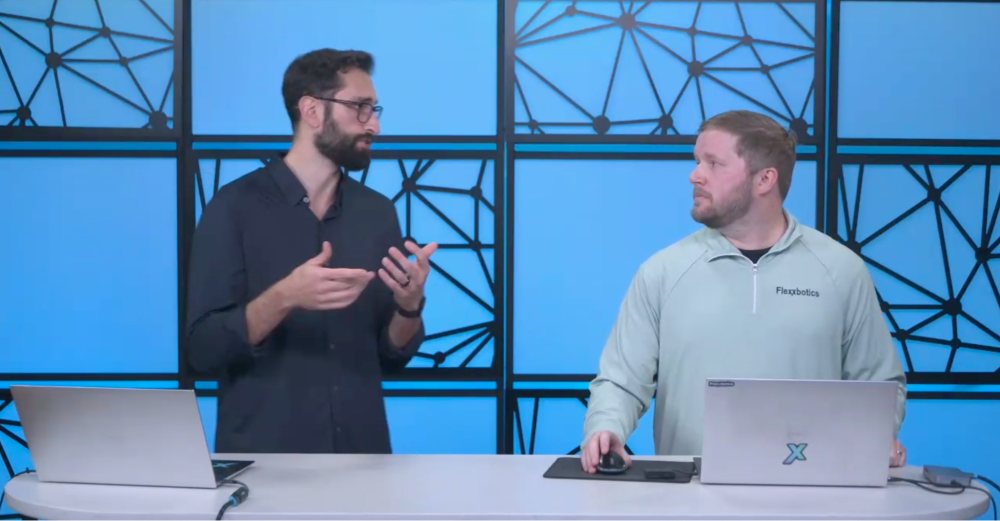
Recently Flexxbotics co-founders Tyler Bouchard (CEO) and Tyler Modelski (CTO) went live on a webinar, From Data to Action. It had a lot of practical information, yet the questions were the best part.
Below is a summary and the conversation: What attendees asked us, what our host moderator Jack Norman pushed on, and some questions we got in the chat. Answers are lightly edited for clarity.
To join our next webinar on December 16th at 3:00pm EST, you can Register Here
The short version
The problem. Demand is up across aerospace and defense, power generation, medical devices, and other critical industries. Plants are adding machines, automation, and software, but complexity is growing faster than the number of experienced people who can run it all.
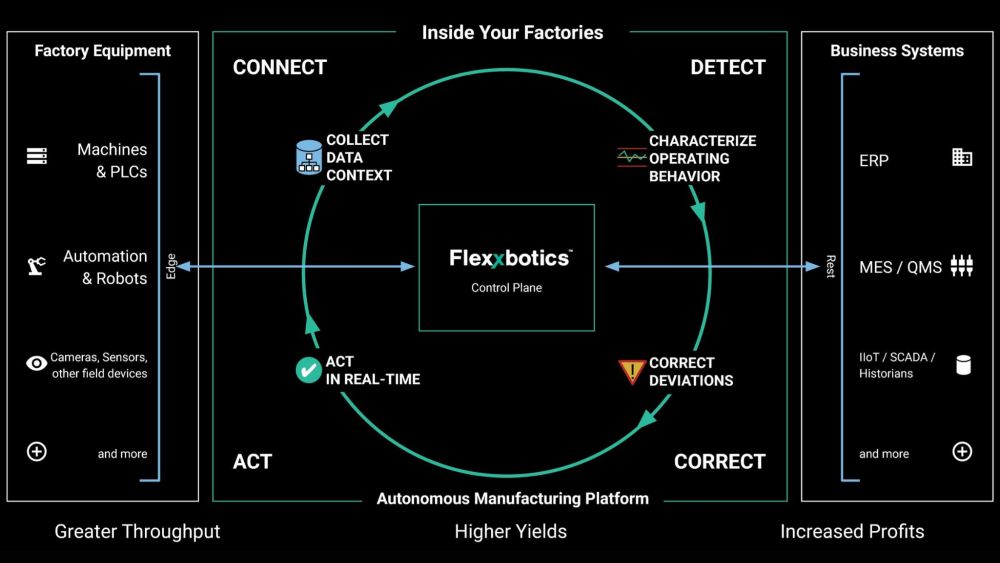
Most production still depends on one or two “gurus” in the plant. And most factories that have connected their machines have ended up with dashboards; which provide better visibility, but are passive / don’t change outcomes. A dashboard can show an alarm. It can’t fix it.
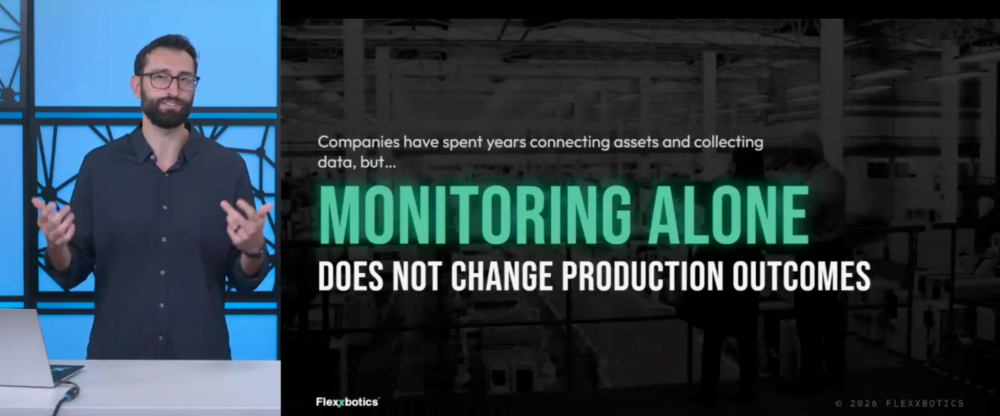
The approach. A four-step closed-loop that turns machine data into controlled action, with your experts in charge:
- Connect. Read (at a detailed level) from every machine and piece of equipment, map data to real tools, operations, and parts, and tie it to work orders.
- Detect. Set characterize control limits for every process variable and find relationships which ones actually drive uptime and quality.
- Correct. Run operating rules in real time to isolate deviations and identify proactive adjustments. Rules determine recommendations; people approve.
- Act. Based on a suggested correction, close the loop with the option to execute an approved action, then automate once the team trusts it.
The proof. Orizon Aerostructures, a critical supplier to Lockheed Martin, Boeing, and Blue Origin, saw a 40% reduction in rework and scrap, 25% less unplanned downtime, and 20% more contract capacity without buying new equipment.
“If one part of this loop is missing, autonomy stalls. Data without detection is just storage. Detection without action is just more alarms.”
Tyler Bouchard, CEO
What the room told us
Before the questions, we asked attendees two things.
- Where are you constrained? Capacity, labor, downtime, or rework.
Capacity 38%
Downtime 27%
Labor 19%
Scrap / Rework 13%
Other 3% - How long does it take to find and fix a problem in your plant? Answers in the chat ranged from days to weeks. Our host’s gut answer: a month.
Answers ranged from 36 hours to 3 weeks or more.
That set the tone for everything that followed.
The conversation
WHERE MOST PLANTS ARE TODAY
We’ve had OEE dashboards up for a couple years. I can’t say they’ve cut our scrap at all. What are we missing?
Bouchard: Dashboards improve visibility, but that visibility is passive. A dashboard can tell you your productivity. Maybe it can even show you a process drifting. It can’t correct the drift. The value shows up when that information turns into a timely decision on the floor.
Modelski: OEE tells you which metrics are off. It doesn’t tell you why they’re off. That’s the missing link. You need the process-level data, with context, tied to the outcomes you care about: quality, downtime, cycle time.
We already run MTConnect into our OEE screens. What would you get that we’re not getting now?
Modelski: Usually it’s the lower-level sensor data. These machines have all kinds of sensors and feedback systems, and MTConnect isn’t capturing all of it. It’ll tell you whether the machine is running, how fast, servo loads, fluid temps, what the last cycle time was, and other data.
We’re not saying don’t use MTConnect. We use MTConnect data, and then we go deeper with protocol-level access to fill in the rest of the picture.
Bouchard: MTConnect is an abstraction layer. It’s not going to give you the full picture.
When something goes sideways on our floor, it’s usually a week or two before we know why. Is that just how it is?
Modelski: I lived this for years before Flexxbotics. Something goes wrong, engineering gets called to the line, and you start chasing what changed. By the time you figure it out, the parts are already bad, the machine’s already down, and the deliveries are already late.
Getting that to hours is good. The real goal is getting proactive, so you’re preventing the problem so that it doesn’t disrupt production.
GETTING THE DATA RIGHT
Our newer machines already talk OPC UA. Why isn’t that enough?
Modelski: Every machine speaks its own language. We use device transformers to translate all of it into one common language, and that means protocol-level signals, not just reading abstracted data.
OPC UA and MTConnect are a start, but on their own they’re often not enough. You need access to registers, macros, and controller APIs to see the whole process.
Bouchard: A lot of connectors are a black box. You can’t configure or customize them, so you go back to the software supplier and wait.
Ours are open and written in Python, so your team can extend them, and LLMs like Claude can help you build new ones much faster.
Tying every signal to a tool and an op sounds like a ton of work. Who’s doing all that?
Modelski: Less than you’d think. A tag coming off a machine doesn’t mean much on its own. You need to know it’s the spindle load for Tool 1, in this operation, on this part.
Today, a lot of that mapping lives in engineers’ heads. LLMs help a lot here. If a shop uses Vericut for tools and simulation, we can upload those outputs as PDFs and let the model do the mapping.
We don’t inspect inline. Everything goes to the CMM at the end. Does this still work for us?
Modelski: Yes, 100%. Every plant tracks work somehow: work orders, job numbers, lot numbers, serial numbers. We tie machine data to those in real time, so you get the full history of every part, how it was made and how it turned out. We call that the part pedigree.
When your only inspection is a CMM at the end of the line, that link matters even more, because it’s how you learn which upstream variables are driving the result downstream.
Half our floor is older than some of our operators. Is this even worth doing on the old stuff?
Bouchard: We built for that. Older machines may give you less data, but there’s still plenty to work with. The value comes in two stages.
First is awareness. One customer had a SCADA system and thought they were capturing what they needed. When we connected on the direct protocols, their words were, “there was 95% of the data we weren’t seeing.” We call that the data iceberg.
Second is insight. That depends on cycle times and how often you run a job, but because of the part pedigree, you can compare a job against its own history every time it runs. We’re talking weeks, not years.
CONTROL AND COMPLIANCE ARE NON-NEGOTIABLE
Why can’t we just dump our machine data into an AI tool and ask it what’s wrong?
Modelski: Without context and traceability across the whole digital thread of a part, it’s very hard for an LLM to understand the relationships in your process. The data has to come first.
Bouchard: We call it a bottoms-up approach. Capture the right data, give it context immediately, and then AI becomes useful. “AI” gets thrown around as a lump term. A lot of what we use is machine learning and statistics that’s been around for decades. LLMs are one more tool in the kit.
There’s thousands of signals coming off these machines. How do you know which ones actually matter?
Modelski: That’s what we call prescriptive optimization. Instead of setting limits by hand, machine learning scores hundreds of thousands of variables against the outcomes you’re trying to fix, like quality on a specific part and operation. It comes back with: here are your top problems.
Bouchard: Then the LLM sifts through those results and explains them in plain terms, so operations knows what to actually do with them.
Is AI making changes on my machines? Because that’s a hard “No” for us.
Bouchard: No. Nothing gets executed on the line by an LLM. Everything is human-in-the-loop approved.
Modelski: The LLM’s job is interpretation: reasoning about the analysis and making suggestions faster. You can run the whole platform, escalations included, without an LLM at all.
Bouchard: It’s the same as using an LLM to write code. It helps the process, but you still own the architecture and the quality control.
Say a hole starts creeping toward the top of tolerance mid-run. What does the system actually do?
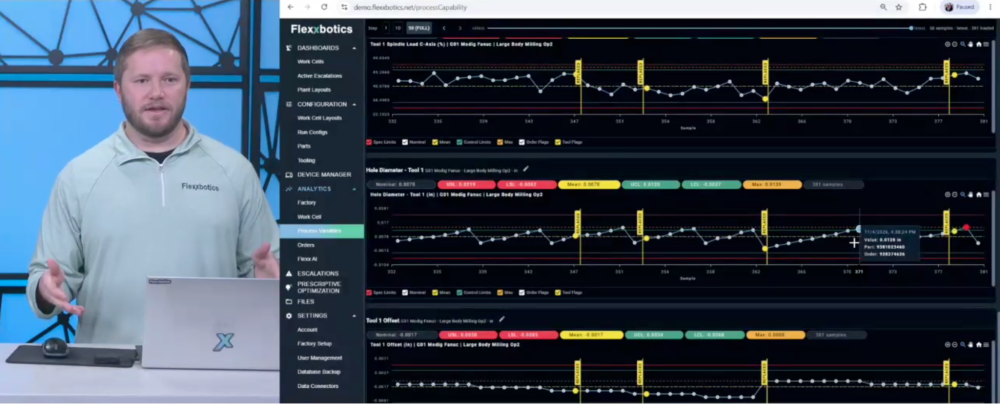
Modelski: We use escalations with operating rules that watch data in real time. In the demo it was hole diameter: if it goes above the upper control limit, offset Tool 1. That rule is the guru’s knowledge, codified in the CAM program and handed to production. You’re not waiting for the part to go out of spec, and you’re not tying up your best person at the line to make sure it gets done.
My guys aren’t going to let software change offsets on its own. How does anybody get comfortable with that?
Modelski: It has to be a governed process to get to that point. You start with suggestions. Your people approve them or adjust them, and those adjustments feed back into the analysis.
Because the connection is two-way, you can still push a change to the machine through a reviewed workflow before you automate anything. Nothing moves to automated on its own.
Bouchard: You want to see a problem recurring that’s handled the same way, then you automate it.
Do we have to use your AI, or can we use whatever IT already signed off on?
Bouchard: No, you don’t have to use AI with Flexxbotics. It’s fully capable without AI. The analysis aspects are faster with AI, but it’s not required. And if you do use it, iIt’s bring your own model.
Modelski: Whether you run models internally or use Anthropic or OpenAI with your own API keys, the data stays inside your operating boundaries. That means your IP and proprietary information stay within your control.
We’re ITAR. If data leaves the building, we’re done talking. Does it?
Modelski: No. Orizon is a good example. They’re in A&D, everything runs inside their own secure boundaries, and ensure ITAR and CMMC requirements. We deploy inside your compliance boundaries.
Bouchard: On-prem, your cloud, government cloud instances, or our cloud. The architecture is highly secure for regulated environments.
RESULTS AND GETTING STARTED
Forget the final numbers. What did Orizon actually see in the first 90 days?
Modelski: We started in a high-impact area: 15 cells making very large aerospace parts, with cycle times around three hours. Scrap one of those and it costs a lot. Their guru was already doing a lot of analysis, but he had gaps, and it took him four or five hours to pull data off the machines. Once we connected, it was at his fingertips. The first 90 days were about opening his eyes to what was possible, cutting their root-cause time, and putting proactive controls in place.
Bouchard: They also found they weren’t running their carbide tools long enough. If you’re in A&D, you know carbide supply is tight. Around day 120, they’d cut tooling costs by about 10%. That went straight to the bottom line.
Our best process guy retires in a couple years and nobody knows half of what he knows. Can this help with that?
Bouchard: That’s the guru problem, and it’s not just retirement. One of our customers is doubling its factory footprint, and each of the people who know the process details are already stretched thin.
Part of winning the contract for the new facility was answering: how will you scale your personnel’s knowledge?
The answer was digitalizing the process control that lives in their heads. That extends their reach across plants and gives new people a data-driven way to learn how things run.
If we wanted to try this, how small can we start?
Bouchard: Start small. We call it an initial production deployment: a line, a cell, or a section of the factory. Prove the results there, then expand.
It also gives you a clear view of what’s achievable in the near, medium, and long term.
Modelski: Just getting the data and looking at it tells you where to focus. Go after the highest-impact areas first.
We want to thank everyone who was able to attend, ask questions, and share in the discussion, and to Jack Norman and his team for hosting the webcast.
Want to See What Flexxbotics Can Do for Your Plants?
Increase your capacity, improve your quality, and scale your experts’ knowledge with closed-loop production.