Hidden scaling problems often emerge when factory automation expands beyond a single cell to multiple lines or plants. This article explores why automation that performs well at the machine level becomes increasingly complex at scale—highlighting challenges with system architecture, integration, standardization, and maintainability across the factory environment.
When people ask “what scales best,” they’re rarely asking about CPU clock rate or memory. In practice, “scale” breaks on integration cost, data consistency, change management, and lifecycle governance – not on whether the PLC line has a bigger chassis. Most major PLC families can scale in raw I/O count or distributed
Additive manufacturing (AM) has matured into a strategic production technology across defense, aerospace, medical devices, semiconductor packaging, and automotive. The engineering advantages are well established: complex geometries, lightweighting, part consolidation,
In the Flexxbotics automation ecosystem, a Transformer is a software component (connector driver) that enables bi-directional, interoperable communication between machine controllers, robotic controllers, PLCs, and diverse factory automation, inspection equipment, or enterprise IT systems. Transformers are central to the
After doing automation deployments for more than a decade, my frustration hit a breaking point. Not with automation itself – this industry is my life – but with how constrained, restricted, and outdated our tooling has become. Every deployment felt like fighting the same battles over and over again, even as factories demanded more
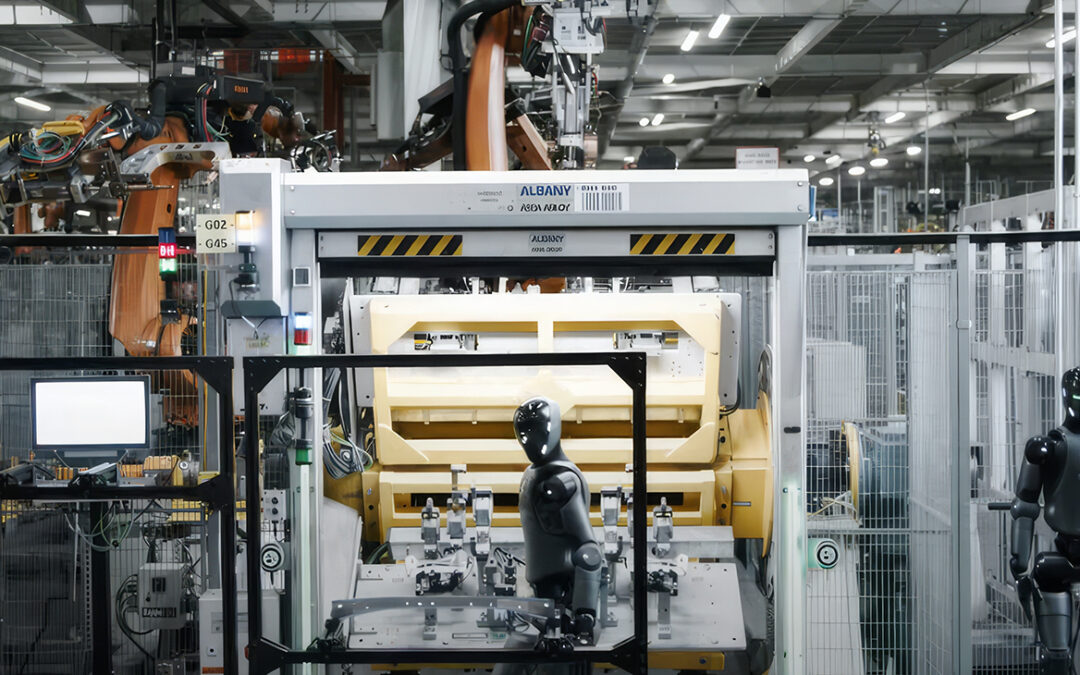
Recently I had the chance to sit down with Jack Hallewell from Humanoid Robotics Technology to talk about the role we see humanoids playing in manufacturing. At Flexxbotics, we’ve been exploring the role humanoids will play in factories, fabs, labs, and other production environments – and how our capabilities make that vision real.




Recent Comments