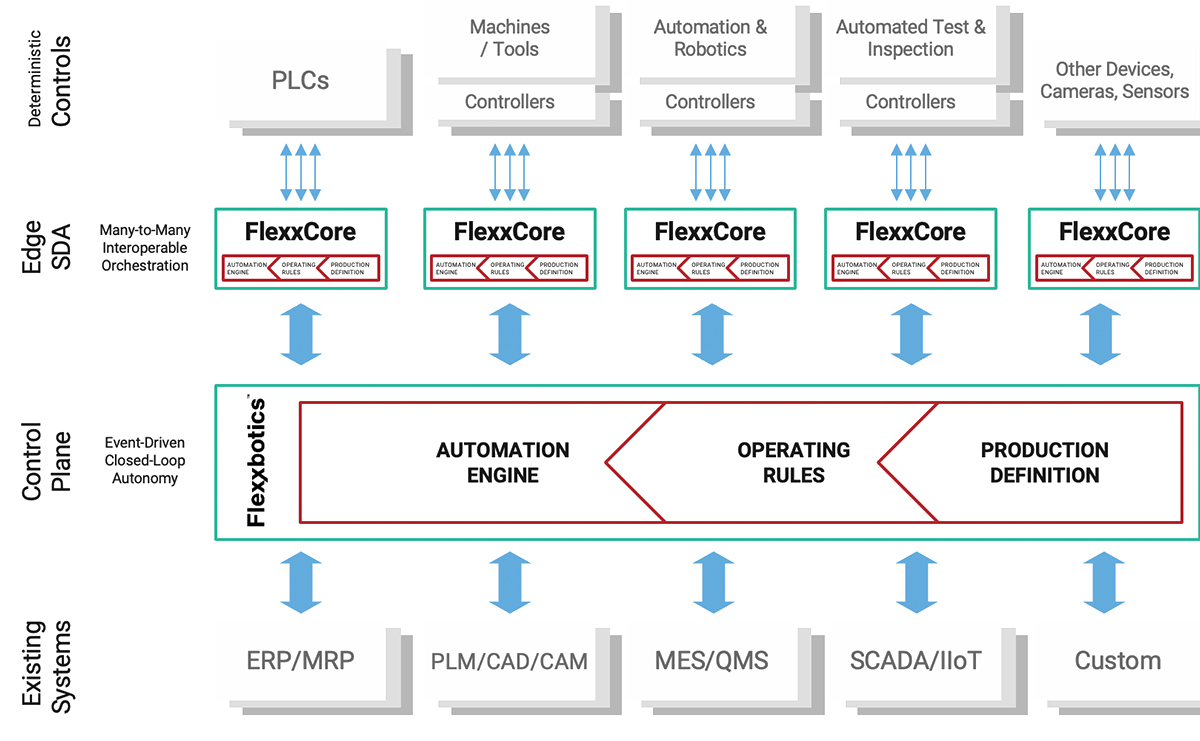

This post is about preparing the factory automation architecture for the controlled introduction of Industrial AI using a layered approach with governance and oversight.
This is the expanded application of advanced process control principles for autonomy in manufacturing with intelligence for compliance and control.
What Industrial Automation Architecture Should Be Used for AI and Machine Learning in Production?
As AI adoption continues to grow, the challenge shifts from experimentation to safe and consistent operationalization in production environments.
Controls engineers and industrial technologists are increasingly under pressure to:
- Apply machine learning to improve yield and throughput
- Use artificial intelligence (AI) for predictive maintenance and quality
- Introduce optimization across lines and plants
Yet most AI efforts stall after proof-of-concept.
The issue is the factory automation architecture required to support AI in production.
This post answers the critical question:
- What factory automation architecture should be used for AI and machine learning in production?
1. The Question?
How do I deploy AI in a factory in a way that actually works in production?
Most factories are already experimenting with AI:
- Computer vision systems
- Predictive maintenance models
- Process optimization algorithms
At small scale, this works:
- Models run offline or in isolated environments
- Insights are reviewed manually
- Limited operational impact
In actual production operations, new challenges emerge:
- AI requires consistent, high-quality data across the factory
- Models need to observe plant activities in real-time
- Recommendations and interactions must be applied safely and consistently
The question is no longer:
“How do I build an AI model for manufacturing?”
It’s become:
“How do I integrate AI into factory operations safely so it can provide reliable information that can improve production?”
2. Why Do AI Initiatives Fail in the Factory?
2.1 Why Is Factory Data Not AI-Ready?
Most factories have large volumes of data:
- Machine signals and states
- Inspection and test results
- Production records
But:
- Data is not contextualized
- What part was being produced
- What process step was occuring
- What was the status of the tool
- Data definitions vary across machine brands, PLCs, and systems
- Data are incomplete or inconsistent
This leads to:
- Poor model performance that erodes confidence
- Extensive effort doing data preparation, cleansing, and transforms
- Trouble meaningfully scaling models
Example:
A defect detection model may fail because:
- Machine states are not aligned with part data
- Process conditions are not consistently captured
Result:
AI projects spend more time preparing data than delivering value
2.2 What Happens When Industrial AI Systems are Isolated?
Most Industrial AI operates:
- On data from weeks or months after actual production occurred
- In separate analytics environments
- Outside of the production environment
This creates:
- Limited access to live machine states
- Long lead times to correct anomalies
- Delays in decision-making responses
Result:
- Insights are generated but not applied
- Engineers attempt to figure out what to do manually
2.3 Why Is There No Controlled Way to Apply AI Recommendations in the Factory?
Even when Industrial AI produces useful recommendations:
- There is no standardized mechanism to apply them
- No governance over when and how actions should occur
- No traceability of data inputs or actions taken
Example:
An AI model recommends adjusting a process parameter:
- One engineer applies it manually
- Another ignores it
- A third applies it incorrectly
Result:
- Inconsistent outcomes
- Relevance and accuracy degrade over time
2.4 Why Doesn’t AI Scale Across Lines and Plants?
AI implementations are often:
- Built for a specific system or situation
- Dependent on custom integrations
- Lacking difficult to access data across the production environment
Result:
- Repeated development and testing efforts
- Isolated results
- Limited production impact
3. What Do Existing Industrial AI Automation Approaches Miss?
3.1 What Are the Implicit Assumptions About AI in Manufacturing?
Most approaches assume:
- The manufacturing system vendor’s AI will be best
- Data lakes are sufficient for AI training and inference
- Insights should only be manually operationalized
These assumptions ignore a critical gap:
To operationalize AI in automated production requires multi-source data context and closed-loop control with traceability across production systems
3.2 Why Is “More Data” Necessary Yet Not Sufficient?
With Industrial AI, most think:
- Increase data collection
- Make bigger data lakes
- Build more models
This leads to:
- Data swamps with unreliable data sets
- Model sprawl, complexity, and conflicts
- Limited operational impact
Industrial AI effectiveness depends on contextualized data and controlled application, not data volume alone
3.3 Does Industrial AI Require Governed Execution?
Yes. Using AI in manufacturing requires controlled introduction, governed operation, and managed oversight to assure issues do not arise or cascade.
AI introduces:
- Probabilistic outputs
- Non-deterministic behavior
Factory environments require:
- Deterministic control
- Predictable execution
- Safety and compliance
Without governed orchestration and traceability:
- AI inputs will not be understood or explainable
- Compliance requirements cannot be demonstrated
- Adoption will continue to be limited
4. What Are Modern AI-Ready Factory Automation Architecture Principles?
Introduce AI in Targeted Use Cases in the Factory
A modern factory automation architecture brings AI safely into the existing processes.
4.1 Contextualized Multi-Source Data Foundation
Purpose:
Provide AI with comprehensive production-relevant data
Responsibilities:
- Enrich machine and controls data at the source with context about parts, processes, jobs, and equipment
- Normalize data across control systems, machines, inspection, and other factory devices
- Combine multimodal data across cells, lines, and plants
Key Principle:
AI models require contextualized production data, not raw signals
4.2 Real-Time Production Observation
Purpose:
Enable AI to observe live operations in ongoing production
Responsibilities:
- See real-time machine states
- Understand event-driven activities
- Consume multi-source high-frequency low-latency data
Key Principle:
To be effective AI must observe production in real-time, using low-latency, event-driven data directly from live machine states and human decisions
4.3 Governed AI in Factory Operations
Purpose:
Control how Industrial AI can interact during production
Responsibilities:
- Validate AI recommendations and conclusions
- Define which actions can and cannot be applied with rules and limits
- Maintain traceability and auditability
Key Principle:
AI generated actions should be governable, traceable, and controlled before they are executed in production
4.4 Industrial AI Across Edge and Enterprise Use Cases
Purpose:
Think of Industrial AI operationalization in layers with respect to scope and production priorities and objectives
Responsibilities:
- Physical AI for real-time responsiveness
- Edge AI for coordination
- Enterprise AI for optimization
Key Principle:
Industrial AI includes machine, edge, and enterprise layers that must align with requirements for real-time responsiveness, coordination, and optimization relative to production priorities
4.5 Key Design Insight
AI becomes increasingly useful when it has full context and traceability within the overall factory automation architecture
5. What Are Practical Implementation Patterns for Industrial AI in Factories?
Flexxbotics implements this in an autonomous manufacturing platform to enable AI-ready factory automation architecture through two architectural layers in the platform: Software-Defined Automation + Control Plane
5.1 Software-Defined Automation at the Edge (FlexxCore)
Enables:
• Multi-Source AI-Ready Factory Data Capture
- Collect high-frequency, multi-modal data from different factory equipment
- Normalize data across protocols and systems
- Continuously enrich multi-source contextualized data sets
• Real-Time Integration
- Enable controlled observation of production environments
- Provide AI systems secure insight to live machine and device states
- Interface independent Physical AI systems in machines and devices
• AI-Assisted Interoperability
- Accelerate development of machine connector drivers for incompatible endpoints
- Assure consistent interoperable patterns for reliability and safety
- Reduce agentic interfacing time significantly
5.2 Control Plane (FlexxControl)
Provides:
• Controlled Governance of Industrial AI
- Establish conditionals and calculation baselines for process thresholds
- Define rules and limits for when and how AI recommended actions occur
- Maintain control over automated workflows
• Detect > Correct > Act with AI
- Identify specific process specifications and job operations
- Combine AI insights with rule-based sequences
- Coordinate trigger actions across systems
• Cross-System Coordination
- Coordinate Physical AI systems with Edge AI for synchronized operation
- Align AI-driven recommendations with business system instructions
- Orchestrate AI outputs with ERP, MES, QMS, and other systems
5.3 Role of AI in Production Operations
Target use cases for Industrial AI introduction in production operations
Apply AI in production with controlled rollout building confidence over time
• Pattern Recognition and Prediction
- Detect anomalies and trends
- Anticipate process deviations based on operational and machine conditions
- Identify unplanned downtime conditions proactively
• Prescriptive Optimization
- Recommend process adjustments using realtime production circumstances
- Increase throughput by identifying inefficiencies
- Improve yield through closed-loop feedback
• Continuous Learning
- Refine models based on real world human decisions
- Establish granular production feedback
- Improve operations over runs
• Controlled Introduction
- Introduce targeted AI use cases incrementally
- Maintain human-in-the-loop oversight
- Control deployment of suggested changes
6. What Does an AI-Ready Factory Architecture Enable?
6.1 From AI Pilots to Production Deployment
From:
- Isolated experiments
To:
- AI assisted production autonomy
6.2 Ongoing Application of AI Recommendations
From:
- Manual interpretation
To:
- Governed repeatable traceability
6.3 Scalable AI Across Plants
From:
- Equipment-specific models
To:
- Production AI capabilities for greater autonomy across factories
6.4 Foundation for Autonomous Process Control
Enabling:
- Process trend intelligence
- Automated manufacturing compliance
- Robotic production
- Factory AI data acquisition
All to achieve:
Autonomous Process Control across plant operations for intelligent lights out manufacturing that increases output, yields, and profitability
Final Takeaway
Your factories need more than:
- More AI models
- Larger data sets
- More experimentation
They need to solve what current industrial automation architectures do not address:
How AI connects to real-time production systems in a safe and reliable way with human oversight to execute recommendations
The Shift
From:
- AI as analytics
- Machine isolated AI models
To:
- AI as a governed operational component
- Integrated within factory systems
- Governed through the control plane
Factories that make this shift move beyond experimentation to operationalize Industrial AI where intelligence continuously improves production performance with greater autonomy