Watch the full Studio Overview demo here: https://youtu.be/zRUaRk_V0pk
Overview
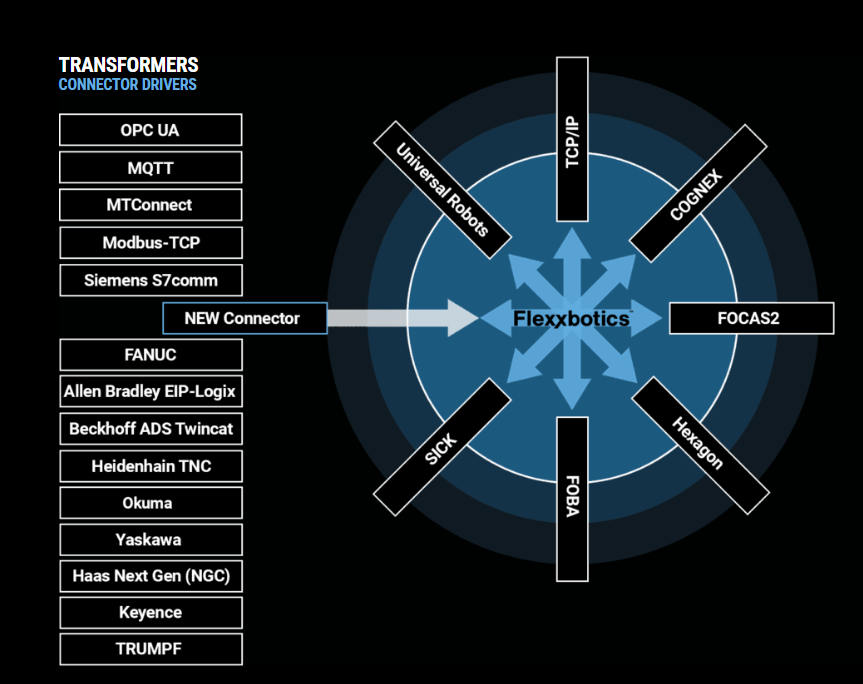
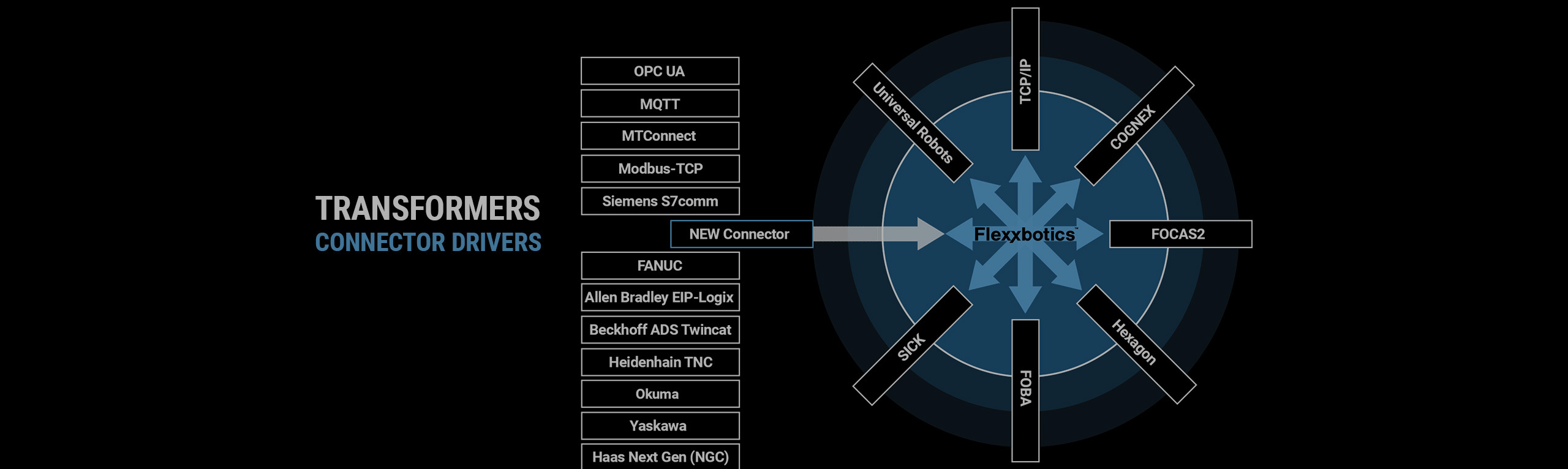
In the Flexxbotics automation ecosystem, a Transformer is a software component (connector driver) that enables bi-directional, interoperable communication between machine controllers, robotic controllers, PLCs, and diverse factory automation, inspection equipment, or enterprise IT systems. Transformers are central to the Flexxbotics FlexxCORE™ architecture and are responsible for translating protocol-specific device messages into standardized data structures used across the platform.
They serve as high-performance translation driver connectors that abstract the complexity of proprietary industrial protocols and machine interfaces, enabling factory software, robots, and automation systems to interface programmatically with a wide range of equipment.
Key Technical Functions
Protocol Translation & Driver Logic
Each Transformer implements the logic to:
- Communicate with specific device types or controller families (e.g., Fab process control systems, CNC controllers, robot brands, etc).
- Translate machine-specific protocols (fieldbus, serial, Ethernet/IP, OPC UA, proprietary APIs) into normalized Flexxbotics messages.
- Enable bi-directional read/write of parameters, status, commands, and events between FlexxCORE and the target equipment.
- This eliminates the need for custom point-to-point integrations or middleware for each machine type.
Data Normalization & Modeling
Transformers map device-specific data points into FlexxCORE’s canonical data model, which:
- Standardizes semantics (e.g., machine state, job progress, sensor values).
- Ensures consistent context for analytic, orchestration, and AI-driven modules within FlexxCORE.
Runtime Integration & Pipelines
Transformers run within the FlexxCORE runtime, which provides:
- Secure, high-performance data pipelines.
- Support for asynchronous and parallel processing.
- Scalability to manage many machines and robots in real time.
They can operate concurrently and are managed by the FlexxCORE orchestrator.
APIs & Extensibility
Transformers expose:
- RESTful APIs to other Flexxbotics modules and external systems.
- Hooks for custom logic or higher-level sequencing scripts.
- Templates and examples exist for extending or creating new Transformers (e.g., GitHub templates).
Role Within Flexxbotics Architecture
In Flexxbotics’ architecture:
- FlexxCORE Runtime Framework – Core low-code, secure runtime for automation interoperability.
- Transformers – Device-specific connector driver modules that translate machine interfaces into FlexxCORE’s unified data plane.
- Application Logic & Orchestration – Uses standardized, multi-source data streams from Transformers for advanced functions like:
- Robot-machine orchestration across many machines.
- Closed-loop autonomous process control.
- Real-time parameter adjustment based on sensor feedback.
Transformers thus act as software adapters that enable many-to-many interoperability – multiple machines with multiple robots – without custom point-to-point interfaces.
Performance & Development Notes
Transformers are designed to support 22× faster connector creation compared to traditional integration methods, thanks to reusable templates and FlexxCORE’s low-code environment.
Typical development involves defining class structures, methods, and data mappings that adhere to FlexxCORE’s runtime frameworks and data models.
They can be maintained or extended via open repositories that include examples (e.g., Universal Robot, Haas NGC controllers, OPC UA, etc.).
Summary
Flexxbotics Transformers are:
- Software connector that translate and normalize machine controller protocols.
- Bi-directional drivers enabling read/write operations between different types of factory assets, equipment, and automation.
- Modular, extensible components within FlexxCORE’s high-performance runtime.
- Key enablers of manufacturing autonomy with autonomous process control.