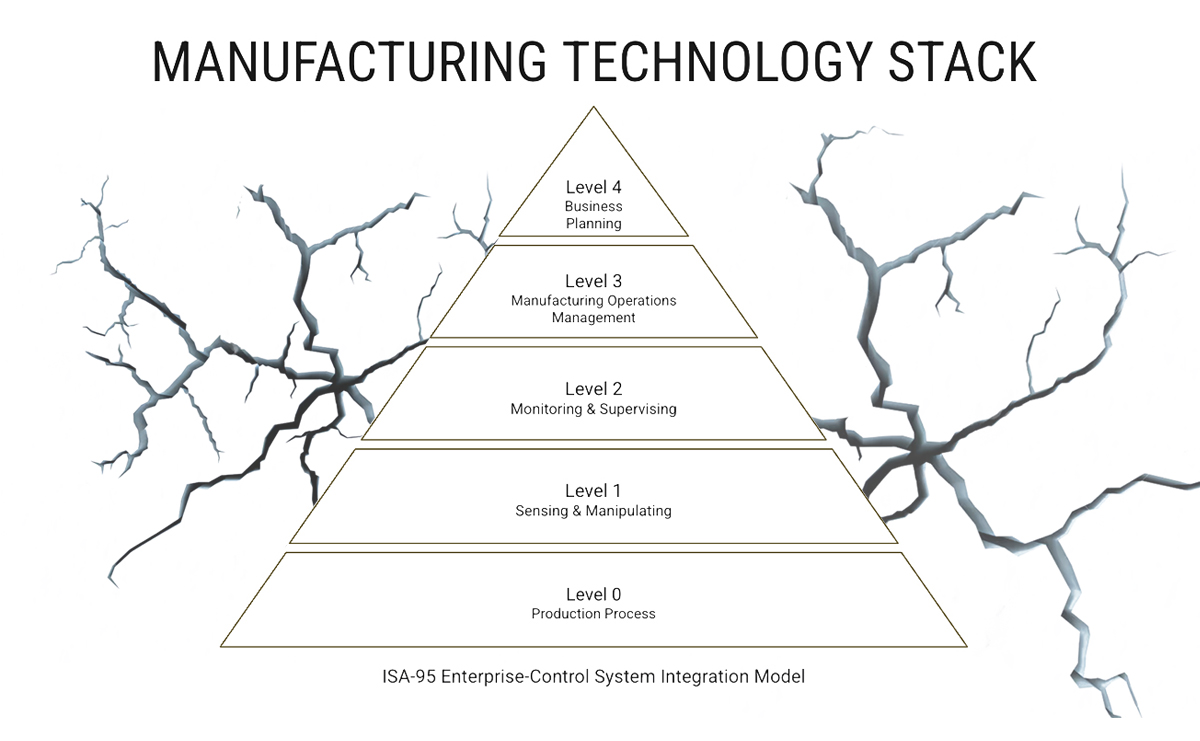

This post explores the breakdown in traditional factory automation architecture for greater levels of autonomy and what patterns and principles can be used for the next era of factory intelligence.
These concepts draw on techniques used for decades in semiconductor fab called advanced process control.
How Should I Structure My Overall Manufacturing Automation Architecture for Greater Autonomy?
Modern manufacturing systems lack architectural clarity at scale, despite having robust control systems.
Automation and controls engineers are being asked to design systems that span:
- Machines and PLCs
- Automation and inspection systems
- MES, QMS, ERP, and enterprise software
Most factories have all of these components. What they don’t have is a coherent architectural model that defines how they should work together.
This post answers four critical questions:
- How do I structure my overall manufacturing automation architecture?
- What is the role of PLC function blocks versus higher-level software?
- How do I ensure real-time performance and deterministic control across systems?
- What is the role of MES in a modern industrial automation architecture?
1. The Question?
How should a modern factory automation architecture be structured for autonomy?
At a basic level, most factories already follow a layered model:
- Machines and PLCs at the control level
- Supervisory systems and HMIs
- MES and enterprise systems
Historically, this works, yet in today’s rapidly unfolding advancement toward greater manufacturing autonomy it is incomplete.
At scale, engineers encounter new challenges:
- Multiple lines with different asset configurations
- Mixed generations of equipment and machines
- Increasing demand for coordination and adaptability
The question is no longer:
“How do I control this machine or line?”
It becomes:
“How do I structure the entire factory as a coordinated system while preserving deterministic control?”
2. Why Does Factory Architecture Break Down at Scale?
2.1 Why Do Industrial Architectures Become Blurry?
Traditional models (e.g. ISA-95) define layers:
- Level 0–2: Machines, sensors, and control
- Level 3: Manufacturing operations (MES/MOM)
- Level 4: Enterprise systems
In practice:
- Responsibilities overlap
- Control blurs between layers
- Systems take on roles they were never designed for
Example:
- PLCs handling coordination and compliance logic across multiple lines
- MES attempting to control real-time logic behavior
- Bridging gaps with custom function blocks, programs, and scripts
Result:
- Unclear control-level ownership
- Difficulty troubleshooting and analyzing root causes
- Inconsistent execution and prolonged periods when unplanned downtime occurs
2.2 Why Does Control Logic Fragment Across Industrial Systems?
Control logic ends up distributed across:
- PLC function blocks
- Automation programs
- MES workflows
- Custom scripts and integration handshakes
This creates:
- Conflicting thresholds and conditionals
- Divergent control routines
- Multiple sources of truth
- Hard-to-maintain logic paths
Example:
An automated process limit deviation may:
- Trigger a PLC stop on one line
- Generate an MES alarm on another
- Require a human check and intervention on a third
Result:
- Factory programs that are only understood by one person
- Inconsistent production output because of downtime
- Increased engineering resources, cost, and time
2.3 Why Do Real-Time and Non-Real-Time Systems Clash?
Factories must balance:
- Deterministic control (millisecond-level timing)
- Higher-level coordination (seconds to minutes)
Problems arise when:
- Non-real-time systems attempt to oversee real-time control directly
- Real-time systems are overload with non-deterministic responsibilities
Results:
- Performance, efficiency, and utilization degradation occur
- Downtime increases affecting production output
- Quality and yield issues increase
- Safety problems happen
2.4 Why Does MES have Overload Problems?
In many cases MES is expected to:
- Track automated production
- Manage line/cell operations
- Coordinate machines and equipment
- Enforce process rules and limits
In reality:
- MES systems are not designed for real-time orchestration
- They lack direct interaction with machine control loops
Result:
- Either over-reliance on MES in real-time scenarios leading to latency issues and process problems
- Incomplete or inconsistent data which leads to a lack of trust in management
3. What Do Existing Industrial Automation Approaches Miss?
3.1 What Are the Implicit Assumptions in Industrial Automation?
Most factory architectures assume:
- PLCs = machine control
- MES = production management
- SCADA/IIoT systems = data and analytics
These assumptions are valid but incomplete.
What is missing is:
A defined architectural platform responsible for coordinating behavior – rules and limits – across systems without violating deterministic control boundaries
3.2 Why Is “More Integration” Not the Answer?
When gaps appear, teams often:
- Add custom handshake logic
- Extend PLC function blocks
- Program one-off MES workflows
This increases:
- Complexity and points of failure
- Interfacing and tight couplings
- Maintenance burden and complexity
Custom integration fills gaps temporarily, but does not resolve architectural ambiguity and complexity.
3.3 Why Does Factory Architecture Need Clear Boundaries?
A scalable industrial architecture requires:
- Clear separation of responsibilities
- Defined interaction patterns between PLCs and factory systems
- Preservation of deterministic control where required
Without this:
- Systems compete for control
- Custom PLC logic skyrockets, diverges, and becomes fragmented
- Scaling becomes exponentially complex and difficult
4. What Are Modern Factory Autonomy Architectural Principles?
Define Clear Roles Across Factory Software Layers
A truly modern factory architecture does not require replacing a lot of existing systems and PLCs; it clarifies their roles.
4.1 Deterministic Control Layer (PLCs & Machines)
Purpose:
- Execute real-time, deterministic control
Responsibilities:
- Machine-level sequencing
- Time-critical operations
- Motion control
- Safety systems
Key Principle:
Deterministic control remains at the machine level and should not be compromised.
4.2 Interoperability & Coordination Layer (Edge)
Purpose:
- Enable communication and coordination across machines, automation, and devices
Responsibilities:
- Normalize communication, function calls, and data structures across protocols
- Share different machine state definitions across systems
- Support line and cell-level coordination
Characteristics:
- Enables interoperability across heterogeneous assets and devices
- Works directly with PLCs (not replacing them)
- Operates reliably at the edge with or without being online
4.3 Orchestration & Traceability Layer (Control Plane)
Purpose:
- Coordinates behavior across production processes and applies adjustments based on closed-loop feedback
Responsibilities:
- Defines rules, thresholds, and conditionals for production coordination
- Contextualizes and enriches production data
- Executes detect > correct > act workflows
Characteristics:
- Enables consistent automated autonomy across processes
- Provides centralized coordination, intelligence, traceability, and governance
- Communicates with MES, QMS, ERP to get instructions and provides back automation execution-level data
4.4 Key Design Insight
As factory automation scales, success depends on separating interoperability, orchestration, and traceability to support autonomy.
5. What Are Practical Implementation Patterns for Modern Factory Autonomy?
Flexxbotics implements this as an autonomous manufacturing platform through two architectural layers in the platform: Software-Defined Automation + Control Plane
5.1 Software-Defined Automation at the Edge (FlexxCore)
Runs at the edge with existing PLCs and controllers in the factory to enable:
Interoperability Across All Different Types of Equipment
- Connecting deterministic controller PLCs, machines, robots, inspection systems, cameras, lasers, safety PLCs, sensors, and other factory devices
- Normalizing data and communication across protocols
Real-Time Coordination Without Disrupting Control
- Share states and statuses across machines with consistent definitions
- Enable interoperable coordination at the cell and line level
Extensible Connectivity
- Many-to-many connector driver interop for full range of factory equipment and automation
- Faster development and extension of machine interfacing using AI-assisted tools
5.2 Control Plane (FlexxControl)
Orchestrates the software-defined automation at the edge to enable:
Centralized Autonomy Governance
- Define production rules, thresholds, limits, and conditionals
- Maintain a single source of truth for production autonomy orchestration definition
Detect > Correct > Act Execution
- Identify production anomalies, drift, and condition changes
- Trigger automated responses and updates
- Safely apply corrections
Works with Existing Business Systems
- Connects MES, QMS, ERP, SCADA, and others to machine-level systems for autonomy
- Aligns automated production with business system instructions
- Provides digital thread traceability of automated production for compliance
5.3 Role of AI in the Factory Automation Architecture for Autonomy
AI can enhance the factory automation architecture for autonomy without disrupting control systems:
Accelerated Development
- Assist in building and testing machine interfacing interoperability connector drivers
Contextual Data Enablement
- Capture and enrich high frequency multi-source production data for AI training, observation, and inference
Human Controlled Decision-Making
- Introduce use case based AI-driven recommendations incrementally
- Assure safe and secure AI inclusion in production processes
- Maintain human oversight and governance
6. What Does a Well-Structured Factory Autonomy Architecture Enable?
6.1 Preservation of Deterministic Control
- PLCs continue to handle real-time operations
- No compromise to safety, timing, or reliability
6.2 Clear Separation of Responsibilities
- Reduced system overlap
- Easier and faster deployment, troubleshooting, and maintenance
6.3 Scalable Coordination Across Systems
- Enable consistent behavior definition across lines and plants
- Reduce need for custom logic, routines, and scripts per deployment
6.4 Foundation for Autonomous Process Control
- Combine interoperability, context, and orchestration to enable autonomy
- Enable incremental autonomy automation for intelligence with oversight
Final Takeaway
The path forward builds on PLCs, deterministic control, and MES/enterprise platforms—by addressing the architectural gaps they leave undefined:
How automation systems coordinate, share context, and execute actions across the factory for greater levels of manufacturing autonomy
The Shift
From:
- Factory systems architectures with blurred responsibilities
- Fragmented orchestration logic across lines/cells/factories
- Point-to-point custom integrations that lack true interoperability
To:
- Clear separation of interoperability, orchestration, and traceability between layers
- Software-defined coordination at the edge with governance through the control plane in an autonomous manufacturing platform
Factories that adopt this structure don’t just enable scalable automation; they create the architectural foundation required of greater manufacturing autonomy that increases output, improves yields, and enhances profitability.
Flexxbotics SDA runtime, studio, and API are freely available at: https://flexxbotics.com/download/