This post looks at the challenges confronted when scaling automation at the factory level or across multiple plants.
Why Does Automation Work in the Cell and Break at the Plant?
Walk into any modern manufacturing plant and you’ll see highly advanced automation:
- PLC-controlled machines
- Industrial robots
- Vision systems
- Torque tools
- Automated inspection & test
- Connections to SCADA and MES
At the cell level, this works really well.
A controls engineer can:
- Integrate machine controllers
- Build handshake logic
- Map tags
- Implement bridging scripts
- Enforce validation routines
The result is a deterministic, high-performing production cell.
But take that same approach and scale it to:
- Multiple stations
- Multiple lines
- Multiple plants
…and something changes.
The automation still works but the system becomes more and more complicated to scale; harder to implement, harder to standardize, and harder to maintain.
This is not a PLC limitation.
It’s an architectural problem.
The Pain: What do Engineers Experience when Scaling?
Senior automation and controls engineers don’t struggle to make systems work.
They struggle to make them scale cleanly.
1) Why does Every Automation Integration Need to be Custom?
Connecting a PLC to anything requires custom logic:
- PLC <> Machine controller comms driver
- PLC <> Robot handshake
- PLC <> Vision system data mapping
- PLC <> Cell transaction logic
- PLC <> ERP/MES system interface code
This logic is typically implemented as:
- Ladder logic
- Structured text
- Function blocks / AOIs
Each integration:
- Is point-to-point
- Is vendor-specific
- Is built from scratch (or copied and modified)
At one cell, this is manageable.
At ten cells, this is painful.
At a plant, it becomes a mess.
2) Why isn’t PLC Logic Reused instead of Rewritten?
In theory… engineers reuse code.
In practice:
- Function blocks/AOIs get copied and modified
- Tag structures differ slightly
- Naming conventions drift
- Edge cases accumulate
The result is not Reuse, it’s Forking.
Example we’ve all lived:
- “Robot_Interface_v1”
- “Robot_Interface_v2_Line3”
- “Robot_Interface_Final_RevB”
Each version:
- Behaves slightly differently
- Requires separate validation
- Cannot be globally standardized
3) Why are PLC Data Models Inconsistent?
Production data, quality records, and traceability data are captured everywhere although not in the same ways or with consistent definitions.
Across lines, you’ll see:
- “PartID” vs “PartNo” vs “SerialNumber” vs “Unit_ID”
- Different structures for the same measurement
- Different timestamp handling
- Missing or inconsistent genealogy
This creates downstream problems:
- Production tracking variability across stations
- Quality data inconsistencies
- Multi-cell automation logic complications
- Cross-line analytics become unreliable
- MES/ERP normalization complexity and integration requires different transformations
4) Why are PLC Changes Risky?
A simple change like adding a new data field or adjusting a process parameter can require:
- PLC code modification
- Scripting edits
- HMI program updates
- MES system interface routine changes
- System revalidation …and sometimes recharacterization or run-off
Because logic is embedded in controllers:
- Testing is difficult
- Deployment risks downtime
- Rollback is non-trivial
So organizations respond predictably:
Everyone avoids change.
5) Why is the Knowledge of PLC Logic Trapped?
Some of the most critical logic in the factory lives inside:
- PLC code
- Vendor-locked tools
- Custom scripts and programs
And usually:
- Inside the head of the original engineer (either at the company or a systems integrator)
This creates:
- Lack of documentation of how the system’s rules work
- Black box logic few understand
- High dependency on a handful individuals
The Problem: What is Custom Automation Code in PLCs?
These issues stem from a long-standing factory automation architectural pattern:
Custom Automation Code
Definition:
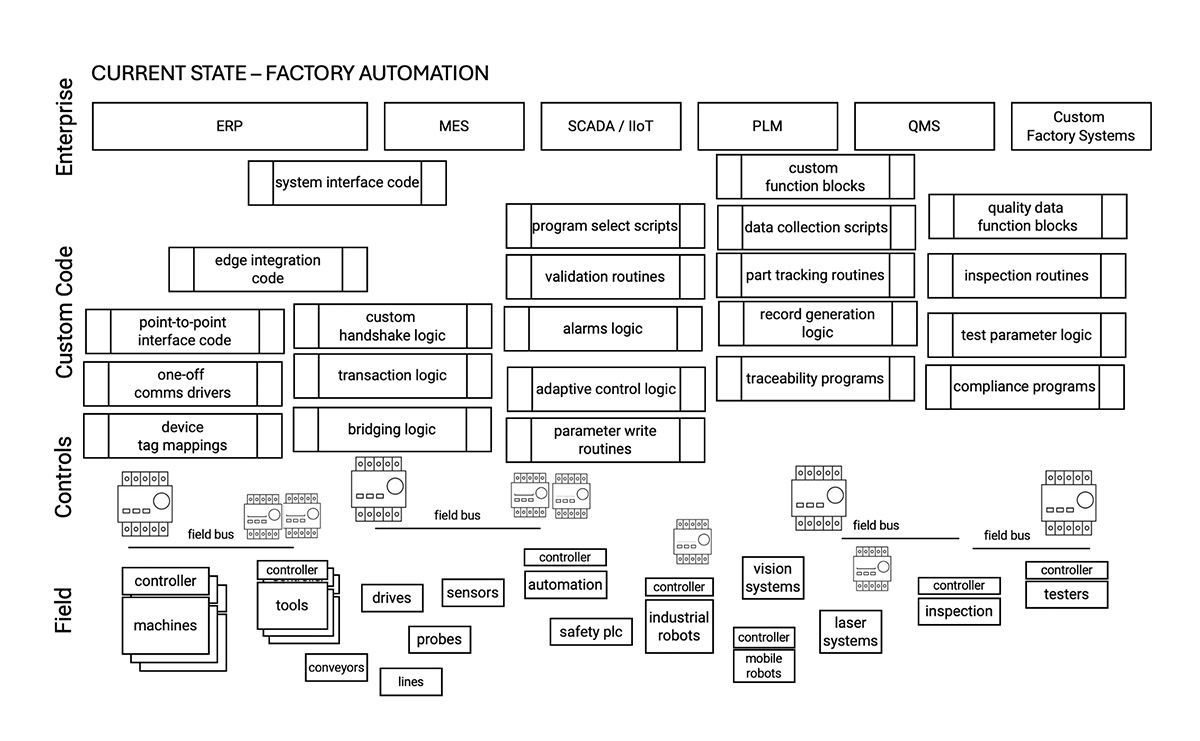
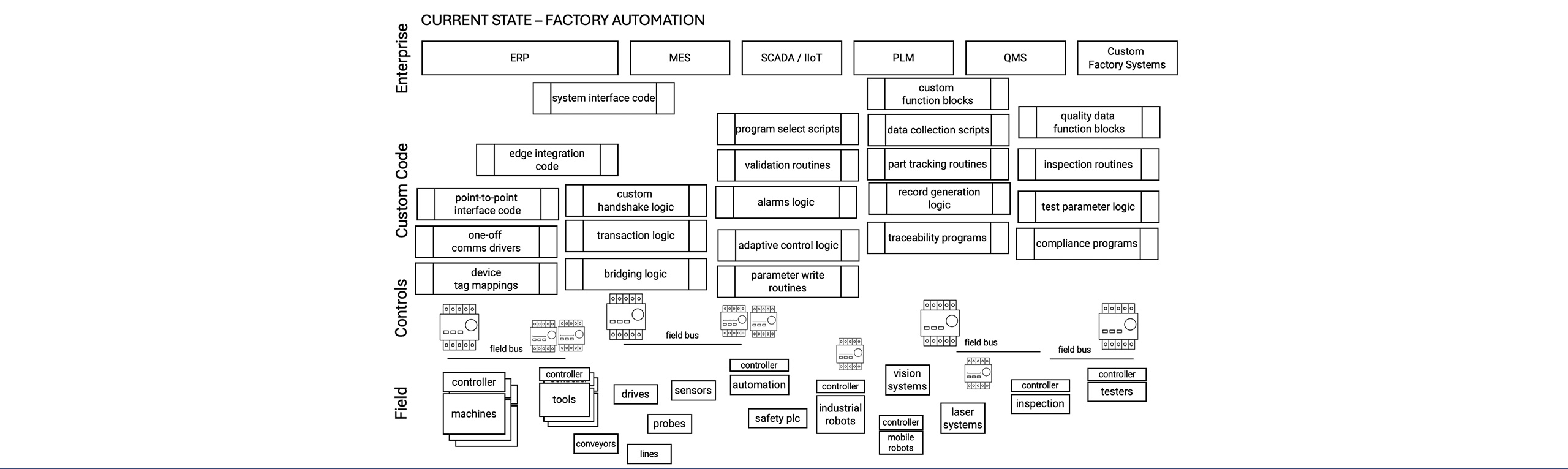
“Custom automation code” are the bespoke programs, logic, scripts, and routines that connect and coordinate the factory machines and systems in your plant to enable automated production yet creates exponential complexity as you automate more and scale it out.
It includes:
- Interface code / comms drivers – between machine controllers, PLCs, tools, automation, cameras, etc.
- Data collection code – data acquisition programs on different factory equipment
- Program select scripts – code to automate program loading for different parts, units, and jobs
- Production tracking routines – logic recording production progress across cells and lines
- Traceability logic – programs that identify and capture unique serial number level traceability in compliance environments
- Quality data logic – critical characteristic measurements and pass/fail records
- Adaptive control logic – mapping matrices and rules for parameter setting, variable/macro updates, offset adjustments, recipe handling
- System interface code – PLCs <> MES / SCADA / ERP / QMS
Why Custom Automation Code Exists
Automation code is not accidental, it’s necessary.
PLCs are designed for:
- Deterministic control
- Real-time execution
- Machine-level coordination
They are not designed for:
- Enterprise data modeling
- Multi-system interoperability
- Reusable integration and control patterns
So engineers solve the problem the only way available:
They write custom logic inside the PLCs and controllers.
Why is Custom Automation Code a Scaling Inhibitor in Factories?
At scale, three structural issues emerge.
1) Point-to-Point Architecture
Each integration is built independently:
- PLC <> Machines 1,2,3,etc
- PLC <> Robot 1,2,3,etc
- PLC <> Vision system 1,2,3,etc
- PLC <> Inspection systems 1,2,3,etc
- PLC <> PLC 1,2,3,etc
- PLC <> SCADA, MES, ERP, etc
There is no shared Control Plane.
Result:
The number of integrations grows faster than the system.
2) Tight Coupling
- Individual devices
- Specific tag structures
- Unique workflows
Changing one system element impacts others.
Result: Systems become hardened, ingrained, and difficult to evolve and adapt.
3) Lack of SEPARATION of Responsibilities
The PLC ends up handling:
- Interfacing
- Control logic
- Data collection
- Quality compliance
- Enterprise systems integration
All within the scan cycle.
Result:
The control layer becomes overloaded with responsibilities it was never designed for.
Example: What is the PLC Scaling Problem in Actual Implementations?
Consider a simple requirement:
Capture serial number, torque result, and pass/fail for each unit and send it to MES.
At One Cell
An engineer implements:
- Barcode scan logic
- Torque tool data mapping
- Pass/fail logic
- MES handshake
This works.
At One Line
Now multiply across 12 stations:
- Each station has several different devices
- Each implementation varies
- Data structures differ
- Integration effort increases significantly
At One Plant
Now:
- Multiple lines
- Different vendors
- Different generations of equipment
- Multiple engineers implementing the logic
You now have:
- Duplicated and divergent logic everywhere
- Lots one-off routines and interfaces
- Multiple tracking & traceability models
- Inconsistent data
At Multiple Plants
Now add:
- Regional variations
- Different integrators
- Different factory systems configurations
At this point:
- Standardization becomes a major engineering initiative not a given.
The Solution: What is a Factory Automation Control Plane?
The core architectural shift is:
Use a factory automation Control Plane platform for interoperable integration, orchestration, traceability, governance rules & policies, and data collection.
This does not replace PLCs.
It reinforces their focus.
PLCs Remain Responsible For:
- Deterministic control
- Machine coordination
- Safety and interlocks
Control Plane Platform Becomes Responsible For:
- Interfacing & interoperability
- Data modeling, normalization, and contextualization
- Multi-cell, multi-machine, multi-job orchestration
- Digital thread traceability and quality compliance data capture
- Enterprise systems connectivity
Flexxbotics Approach: Why use a Software-Defined Automation Control Plane for Manufacturing Autonomy?
Flexxbotics addresses the factory automation scaling problem by reducing the need for custom automation code through:
1) What is Many-to-Many Interoperability in Industrial Automation?
Instead of point-to-point connections:
- Factory machines, test & inspection equipment, tools, automation, robots, and systems connect through a common platform and all interoperate
Connector drivers, called Transformers, standardize compatibility and are reusable across lines and plants.
2) Why are Standardized Data Models important in Factory Automation?
Data is:
- Normalized
- Contextualized
- Consistent across your factories
This eliminates:
- Differing data models
- Per-line data transforms and translations
- Inconsistent traceability structures
3) Why Use a Standardized Control Plane for Factory Data and Process Context?
Traceability, quality, and process data are handled in the Control Plane instead of PLC registers:
- No need to embed complex data logic in ladder code
- Reduced PLC program complexity
- Improved logic capture and governance
4) Why is High-Frequency Multi-Source Data Acquisition Important?
Using software-defined automation as a Control Plane platform such as Flexxbotics enables:
- Real-time multimodal data capture across heterogeneous systems
- Enrich raw production data with operational context
- Consistent structure for analytics and AI training, validation, and inference
The Value: What Changes for Automation & Controls Engineers?
When custom automation code is minimized using the control layer:
1) Why does Factory Asset Integration Become Reusable?
- Standard many-to-many drivers replace custom point-to-point integrations
- Once built, deploy repeatably
- Data model and field definitions are standardized
- Multimodal data become contextualization and enrichment
2) Why do Manufacturing Systems Become Easier to Change?
Changes occur in sustainable software-defined automation, not custom PLC logic
- Reduced downtime risk
- Greater control over logic
- Faster iteration
3) Why do Production Data Become Consistent?
- Data granularity, consistency, and contextualization enable greater factory intelligence
- Unified data model and name space alignment
- Normalized data element capture and traceability
- More reliable cross-line and cross-plant analytics
4) How do PLC Programs Become Effective?
- Control logic is not merged with interfacing, tracking, and bridging
- Focused on control, not integration
- Deterministic responsibility, not coordinating governance
- Easier to validate and maintain
5) How does Factory Automation Repeatably Scale?
Most Importantly:
Adding a new line no longer means rewriting the same logic again or forking custom code.
The Bottom Line:
The constraint in modern manufacturing is no longer the physical automation, but the system’s architecture required to integrate and orchestrate automation at scale.
PLCs scale.
Custom Automation Code does not.
Until scalable factory interoperability, orchestration rules, and data contextualization are treated as factory automation software architecture problems – rather than embedded controller logic challenges – plants will continue to experience complexity barriers that make automation expensive and difficult to install, maintain, and adapt into the future.
How to Enable and Control Industrial AI and Physical AI Systems?
Once factory interoperability and data normalization are established, this becomes the data foundation for new capability insertion such as the controlled introduction of Industrial AI.
Industrial AI systems require large volumes of consistent, contextualized production data to train and operate effectively.
This includes:
- Granular high-frequency machine and automation operating data
- Process parameters, variables, and values over time (including calculated values)
- Inspection and test result measurements and control limits
- Production, traceability, and compliance records
When this data are fragmented across machine controllers, PLC registers, data historians, and factory systems databases, AI models cannot reliably interpret production conditions.
By externalizing interoperability and standardizing data capture, the Control Plane platform architecture enables the type of structured and contextualized cross-machine data environment required for:
- Predictive quality models
- Adaptive process optimization
- Autonomous production orchestration
Physical AI systems that coordinate vision systems, robots, machines, and tools across production workflows require orchestration with governance for control and compliance.
Solving the factory interoperability problem is a prerequisite for deploying Industrial AI and orchestrating Physical AI at production scale.
What is the path forward for industrial automation and factory autonomy?
- Separate control logic from interoperable integration
- Enable PLCs to focus on deterministic control
- Use a software-defined automation Control Plane platform instead of writing custom automation code
Flexxbotics compatibility extends to over 1000 makes & models of factory equipment and connects openly with the major IT systems to empower and extend your existing plant capabilities for greater levels of manufacturing autonomy.
Flexxbotics autonomous manufacturing platform enables smart factory autonomy at scale. Software-defined automation provides interoperable communication and orchestration across plant equipment, robotics, and enterprise IT systems. More powerful, flexible and open, Flexxbotics digitalizes next-generation production environments for continuous operations.
Flexxbotics SDA runtime, studio, and API are freely available at: https://flexxbotics.com/download/