Many of the concepts discussed in this post are drawn from techniques established in semiconductor fabrication for decades called advanced process control.
Taking these foundational methods, applying them across manufacturing for all industries, and extending them to modern smart factory environments, whether using AI or not, is the intent.
How Do I Achieve True Closed-Loop Production Autonomy Across Machines, Systems, and Processes?
As factories scale automation and introduce AI, the challenge shifts from coordinating systems to achieving consistent, real-time control of production outcomes.
Controls engineers and manufacturing automation technologists are increasingly expected to:
- Maintain tight tolerances and quality across complex processes
- Reduce variability, scrap, and rework
- Improve yield and throughput continuously
- Enable lights-out production with minimal human intervention
Yet most factories still rely on:
- Machine-level control loops
- Operator-driven adjustments
- Delayed responses to process variation
The automation capabilities exist, yet the ability to execute closed-loop control across the entire production environment is not there today in most plants.
In modern factories Autonomous Process Control (APC) is the foundational building block for autonomous manufacturing. If APC can not be achieved, repeatable manufacturing autonomy is unrealistic.
This post answers the critical question:
- How do I implement Autonomous Process Control across factory systems to achieve consistent, scalable production autonomy?
1. The Question?
How do I extend process control beyond individual machines to the entire production process?
Most factories already implement some level of process control:
- PLC-based control loops
- Machine-level feedback systems
- Inspection, test, and quality checks often later in the process
Historical this mostly manual approach works:
- Operators and inspectors monitor outputs
- Adjustments are made manually
- Variability is manageable
As production automation density scales, new challenges emerge:
- Variability accumulates across machines and processes
- Process drift is detected too late
- Adjustments are inconsistent across cells, lines, and shifts
The question is no longer:
“How do I control this machine?”
It becomes:
“How do I continuously control production outcomes across a wide range of machines, automation systems, and processes in real-time?”
2. Why Does Process Control Break Down at Scale?
2.1 Why Is Control Limited to the Machine Level?
Traditional factory architectures concentrate control within:
- PLCs
- Machine controllers
- Local feedback loops
This creates:
- Strong local deterministic control
- Complicated system-level coordination
Result:
- Machines operate correctly in isolation
- Production outcomes vary across cells, lines, and plants
2.2 Why Is There Not More Closed Loop Between Production Operations?
Most factories separate:
- Production systems (machines, equipment, automation)
- Inspection & test systems (automated testers, inspection, optical, CMMs, etc)
- Factory data analysis (manufacturing, quality, maintenance event data)
This leads to:
- Long feedback loops requiring human interpretation and intervention
- Inspection results analyzed after production occurs
- Adjustments applied manually or inconsistently after the fact
Result:
- Delayed corrections and prolonged downtime
- Increased defects, rework, and scrap
- Missed opportunities for proactive optimization
True Autonomous Process Control requires closing this loop, where feedback directly drives production adjustments in real-time
2.3 Why Does Process Variability Persist?
Production variability is introduced by:
- Material differences
- Environmental conditions
- Tool wear and degradation
- Machine drift
Without coordinated control:
- Variability compounds across operations
- Intervention is reactive, not proactive
- Adjustments do not occur continuously
Result:
- Throughput bottlenecks and reduced output
- Unplanned downtime
- Inconsistent quality and yields
2.4 Why Is Human Intervention Still Required?
Most factories depend on:
- Operator and inspector interpretation
- Engineers analyzing and making adjustments
- Tribal knowledge for process tuning
This creates:
- Inconsistent responses
- Delayed decision-making
- Areas of dependence on a single person
- Systemic drift and downtime risk
- Limited ability to scale
Result:
- Production performance is over-reliant on individuals, not systems
3. What Do Existing Approaches Miss?
3.1 What Are the Implicit Assumptions in Process Control?
Most architectures assume:
- PLCs handle control
- Inspection and test systems validate results
- MES tracks production
These assumptions leave a gap:
No system is responsible for continuously aligning production behavior with throughput, uptime, and quality outcomes across the factory
3.2 Why Is Machine-Level Control Not Enough?
Machine-level control ensures:
- Repeatability within a cycle
- Stability within a machine
But does not ensure:
- Consistency across machines, lines, and processes
- Processing adjustments based on quality outcomes
- Proactive corrections to avoid downtime
- Optimization across the full production process
3.3 Why Does Self-Correcting Control Require a Closed-Loop Architecture?
Autonomous Process Control requires:
- Multi-source data
- Real-time feedback
- Immediate adjustments or corrections
Without a closed-loop architecture:
- Control is dependent of individuals
- Adjustments are delayed and inconsistent
- Scaling becomes difficult
4. What Are Modern Principles for Autonomous Process Control?
Extend Process Control Beyond the Machine
A modern factory automation architecture for autonomy must treat process control as a system-wide capability, not a machine-level function.
4.1 Closed-Loop Factory Automation Architecture
Purpose:
Continuously align production processing with output and quality requirements
Responsibilities:
- Enable all production equipment to interoperate with continuous feedback loops
- Feed data streams into a control plane for anomaly detection and event recognition
- Enable real-time adjustments and corrections
Key Principle:
Process control becomes autonomous when production activities are continuously linked in a closed-loop
4.2 Contextualized Process Control
Purpose:
Ensure adjustments are applied correctly
Responsibilities:
- Enrich multi-source production data with part, process, and equipment context
- Characterize nominal values and control limits for every data stream
- Apply adjustments based on actual production conditions
Key Principle:
Process adjustments must be based on characterized production data streams, not isolated signals
4.3 Real-Time Detection and Response
Purpose:
Reduce latency between condition and correction
Responsibilities:
- Detect process drift immediately
- Trigger adjustments without delay
- Maintain continuous control
Key Principle:
Effective process control depends on immediate detection and response to production condition changes (minutes or seconds as opposed to hours or days)
4.4 Governed Implementation of Adjustments
Purpose:
Ensure safe and consistent control
Responsibilities:
- Define rules, thresholds, and limits
- Control which adjustments are allowed
- Maintain traceability of actions
Key Principle:
Autonomous process control requires governed oversight to ensure reliability and compliance
4.5 Key Design Insight
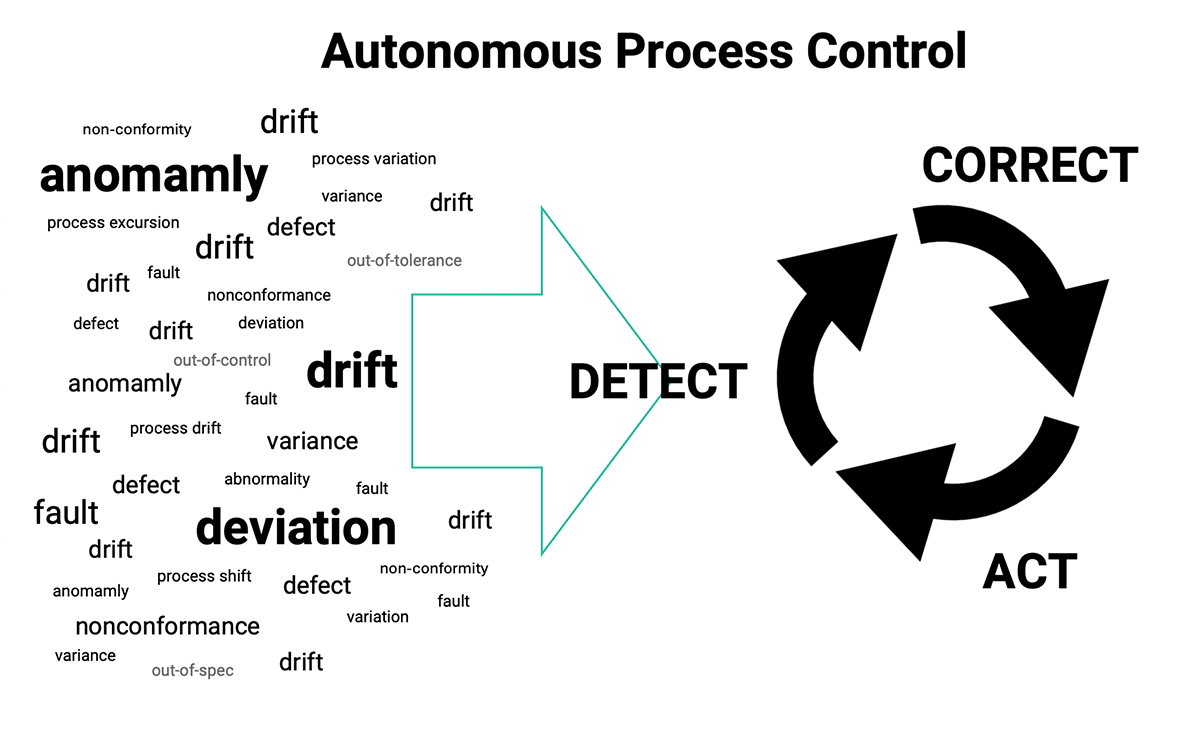
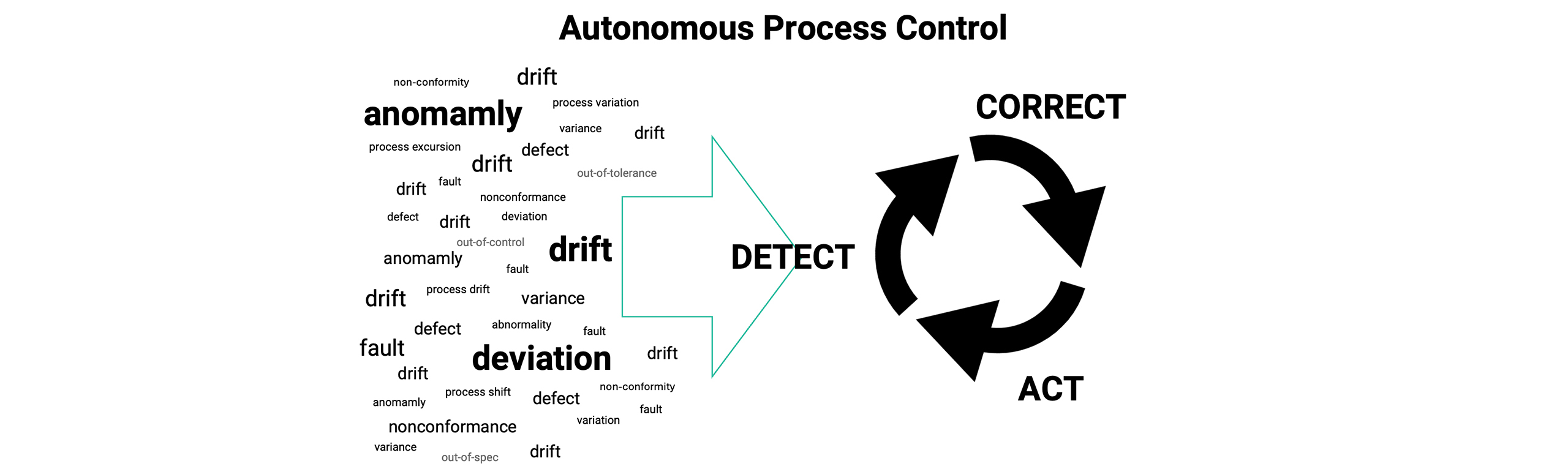
Autonomous Process Control is only possible when interoperability, orchestration, and traceability are combined into a closed-loop detect > correct > act process across the production environment
5. What Are Practical Implementation Patterns for Autonomous Process Control?
Flexxbotics enables Autonomous Process Control through an Autonomous Manufacturing Platform using a Software-Defined Automation layer + Control Plane layer
5.1 Software-Defined Automation at the Edge (FlexxCore)
Enables:
Real-Time Factory Equipment Interoperability
- Connects machines, automation, test & inspection equipment, cameras, sensors, safety systems, and equipment for secondary operations
- Enables direct feedback loops between all equipment during production
Contextualized Data Capture
- Aligns machine data with part, process, job, and other production relevant context
- Normalizes multi-source, multimodal data across heterogeneous systems
Event-Based Process Detection
- Identifies drift, variation, and anomalies in real time
- Triggers conditional adjustments at the source
5.2 Control Plane (FlexxControl)
Provides:
Centralized Process Governance
- Defines operating rules, thresholds, and limits
- Ensure consistent process control across cells and lines
Detect > Correct > Act Automation
- Identify deviations and anomalies
- Calculates adjustments
- Applies authorized corrections to production variables and parameters
Cross-System Coordination
- Aligns factory machine behavior with ERP, MES, QMS, and PLM defined specifications
- Ensure production meets business and compliance requirements
5.3 Role of AI in Autonomous Process Control
Artificial Intelligence is not required for Autonomous Process Control, however, AI/ML can be used with governed oversight to enhance APC in range of targeted ways:
Pattern Recognition
Identify trends and anomalies across production as data streams scale and become overwhelming
Predictive Adjustment
Identify drift based on prior patterns before defects or downtime occur
Prescriptive Optimization
Recommend process adjustment improvements using insights from production observations
Controlled Introduction
Incrementally apply AI into specific production use cases with human oversight and governance
6. What Does Autonomous Process Control Enable?
6.1 From Reactive Intervention to Continuous Control
From:
- Manual adjustments
To:
- Continuous real-time correction
6.2 From Isolated Machines to Coordinated Production
From:
- Machine-level control
To:
- Factory-wide process control
6.3 From Variable Quality to Consistent Output
From:
- Drift and variability
To:
- Stable, repeatable production
6.4 Measurable Production Improvements
Autonomous Process Control delivers:
- Reduced defects and nonconformances
- Increased yields
- Improved profitability
6.5 Foundation for Autonomous Manufacturing
APC enables:
- Process trend intelligence
- Automated manufacturing compliance
- Robotic production
- Factory AI data acquisition
All to support:
Autonomous Process Control as the foundation for fully autonomous manufacturing
Final Takeaway
Factories already have:
- Machine-level control
- Inspection systems
- Automation infrastructure
The remaining challenge is extending control across the production environment:
How production systems continuously detect, recognize, and act to maintain process outcomes automatically
The Shift
From:
- Machine-level control loops
- Manual adjustments
- Disconnected inspection and production
To:
- Closed-loop factory-wide control
- Real-time coordinated adjustments
- Governed execution across systems
Factories that make the shift to Autonomous Process Control do not just improve automation performance.
They establish the capability required for greater levels of manufacturing autonomy enabling intelligent manufacturing operations at scale.